.png)

What Is the Role of Clay Content in Baseball Infield Mix Performance?
Published on:
May 4, 2026
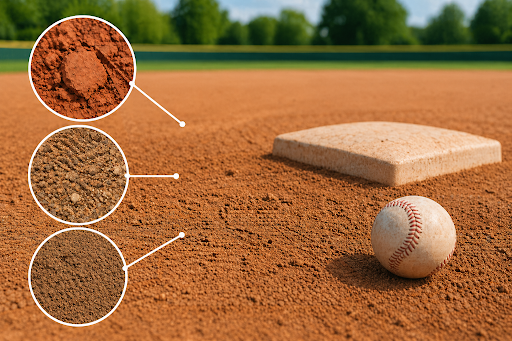
The key factor influencing baseball infield mix performance but often overlooked is the clay content in the mix. Field-related injuries are frequently caused by playing surfaces that are too hard, too soft, or unpredictable, and most of these surface problems are directly linked to the composition of the infield itself.
If you manage or maintain a baseball field, you already know how quickly a surface can go from playable to problematic. One stretch of dry weather, one heavy rain, and the field behaves completely differently. A lot of that inconsistency comes down to clay content in the infield mix.
The main argument here: the performance of a baseball infield starts and ends with the clay percentage in its mix.
Understanding how clay content influences a field is essential for safer, higher-quality play.
What a Baseball Infield Mix Is Actually Made Of
Most people assume infield dirt is just dirt. It is not.A proper infield mix for a baseball field is a carefully proportioned blend of sand, silt, and clay, each playing a defined role in the science behind baseball field dirt and overall surface performance.
Sand handles drainage. It keeps the surface from holding too much water and compacting into a hard slab. Silt smooths out the texture and fills the space between larger particles. Clay is the glue. It binds the whole mix together and controls how firm or soft the surface feels underfoot.
A commonly used starting ratio is around 60 to 70 percent sand, 20 to 25 percent silt, and 10 to 15 percent clay. Those numbers exist for a reason. They reflect what actually works on real fields over full seasons of use. Shift any one of them too far in either direction, and the problems show up quickly.
What Clay Actually Does on a Baseball Field
Clay is the most influential material in the mix. It is also the easiest to get wrong.
Here is what it controls on the field:
Surface Firmness and Player Safety
Clay determines the firmness of the infield and, as a result, impacts both player safety and field performance. When the clay percentage is incorrect, the surface can become too soft or unstable, complicating player movement, reducing traction, and increasing the risk of injuries. Excessive clay, on the other hand, produces a surface that becomes rock-hard in dry weather and sticky after rain—again, increasing safety risks. In summary, getting the clay percentage right is critical for player safety and reliable field performance.
Ball Behavior
The way a ball moves after it hits the ground is directly tied to how the surface is built. A balanced baseball infield clay mixture shows you predictable bounces while maintaining constant roll speed.
Fielders learn to read those bounces and adjust. When the surface is inconsistent because the clay is off, those reads become unreliable, and errors go up.
Cracked dry patches from too much clay or soft spots from too little both disrupt ball behavior in ways that affect the outcome of actual plays.
How the Field Handles Water
Clay retains moisture. The right amount keeps the surface just firm enough without turning dusty or crumbly on hot days. It also gives groundskeepers some control over field conditions through watering. Too much clay and water sit on top too long, making the surface dangerous and delaying games. Too little and the field dries out fast, kicks up excessive dust, and degrades quickly under foot traffic.
Get the right infield mix for lasting performance.
Request a Quote Today
So What Type of Dirt Is Actually Used for Baseball Fields
This comes up often, and the answer surprises a lot of people. What type of dirt is used for baseball fields at a serious level is not natural ground soil. It is an engineered mix made from processed materials selected for specific performance characteristics.
The clay used in quality baseball infield mixes is typically calcined clay or a brick-based clay blend. The materials undergo processing to achieve uniform particle dimensions, which create predictable binding properties that prevent both clumping and rapid material degradation. The topsoil from landscaping suppliers does not provide an exact match to this specific requirement. The particle structure is completely different, and the field will show it within a season.
This distinction matters whether you are managing a high school field or a competitive adult league. The base material you start with sets the ceiling for how well the field can ever perform.
Clay Content and Day-to-Day Maintenance
Here is something field managers learn the hard way. The clay percentage you start with determines how much ongoing work the field demands throughout the season. Especially when trying to maintain baseball dirt for long-lasting playability under changing weather and field conditions.
A well-balanced mix dries at a reasonable pace after rain or watering. It drags and levels smoothly. Repairs hold because the new material bonds with the existing surface. The field stays consistent from the first week of the season to the last.
A mix that is off in either direction fights you constantly. Low clay fields break apart under heavy use and need frequent material additions to stay playable. High clay fields crack during dry spells, resist dragging, and stay wet too long after any significant moisture. Both situations eat into maintenance time and budget fast.
Choosing the right baseball infield mix upfront is genuinely one of the most cost-effective decisions a field manager can make.
Climate and Usage Change What Works Best
There is no single clay percentage that works perfectly for every field everywhere. Local conditions matter.
The surface in hot and dry climates benefits from higher clay content because it retains moisture for extended periods while maintaining its strength without needing frequent irrigation. The field area exceeds its playable condition after rain when operators use clay materials that meet the minimum recommended range in wetter regions.
Usage frequency matters just as much. A field used every day for practice and games wears down faster than one used twice a week. Heavier traffic generally calls for a mix that leans a bit higher in clay to hold up under the repeated stress.
Knowing your field's specific conditions before choosing a mix is not overthinking it. It is just good field management.
Wrapping It Up
Getting clay content right is not just a detail, it makes the difference in player safety, play consistency, drainage, and maintenance. With proper knowledge and the right materials, field management is set up for long-term success.
Whether you are building new or updating an existing field, base your project on a smart mix. At Western Materials, we provide high-quality infield mix solutions designed to meet the demands of every sports program, location, and season. Partner with our team for customized solutions that keep your field performing at its best.
Get quality baseball infield mix for better play and longer-lasting field performance.
Order Your Infield Mix Today
Frequently Asked Questions
Q: What clay percentage is best for Baseball Infield Mix Performance?
A: For most fields, 10 to 15 percent clay hits the right balance for strong Baseball Infield Mix Performance, improving firmness, drainage, and long-term durability. At Western Materials, our team helps field managers find the right ratio based on climate, field conditions, and how often the surface gets used. Every field is a little different, and the mix should reflect that to ensure consistent playability and player safety.
Q: Does clay content affect how the ball plays off the infield?
A: Yes. Each baseball field material affects playability and safety. Clay controls surface firmness and how evenly the ground compacts under use. The detected elevation of 22 percent clay content leads to predictable bouncing patterns and uniform ball movement. The ball movement across different areas of the surface changes because clay detects uneven distribution, which creates soft areas and hard areas.
Q: What type of dirt is used for baseball fields at higher levels of play?
A: Engineered infield mixes with processed calcined or brick clay, not natural soil. The clay is selected for particle size and binding strength so it performs consistently. Natural soil varies too much in composition to deliver reliable results across a full season of play.
Q: How do you know if your infield mix has too much or too little clay?
A: Insufficient clay quantity causes construction materials to produce a loose, dusty surface, which breaks apart easily and lacks stability for foot traffic. Excess clay creates visible cracks that remain present after the material dries and retains moisture for an extended period following precipitation. The field provides two different methods to show its condition. A soil test can confirm the exact ratio and take the guesswork out of adjustments.
Q: How often does an infield mix need to be replaced?
A: Most fields need a material refresh every one to two seasons for high-use fields and every two to three seasons for lighter use. A full replacement is typically necessary every five to seven years. Staying on top of smaller refreshes extends the life of the full mix and keeps performance consistent year over year.
.avif)
Materials management and founders
have produced and supplied high quality
sand and gravel to contractors &
aggregate users across California.
.svg)
.svg)


